Creator Income Examples 2026: 8 Real Case Studies
Creator income in 2026 ranges from a few thousand dollars a year to multiple six figures, and follower count barely predicts which creators land where. The examples below are sourced, named, and specific — and they share one pattern: every low-follower, high-income creator sells UGC, affiliate, a service, or a high-ticket offer. None of them earn their real money from platform payouts or viral reach.
We pulled eight cases from the Creator Money Playbook and put the numbers side by side. Read them for the pattern, not the personalities.
What do real creator incomes look like in 2026?
Here is the reported annual income for the seven examples with comparable yearly figures, on one scale. The eighth case is a per-deal rate, so it stays in the case-study section rather than being forced into an annual estimate. The spread is the story: a $2,539 floor and a multi-six-figure ceiling, with follower counts that do not line up with either end.
Source: CreaMate Playbook case pull, 2026. Estimates from Business Insider creator profiles, Collabstr 2026, beehiiv, and Gumroad self-reported data. Red = the realistic floor; green/blue = income built on a service, offer, or affiliate — not reach.
None of these bars are drawn from view payouts. Hold that thought while you read the cases.
The case studies, by income path
Gigi Kovach — Instagram, 13.5k followers, $500 starting rate for an in-feed post. A family-and-food nano-creator who reported a $500 starting rate for one sponsored feed post and $75–100 for a typical set of three Story slides in December 2020 (Business Insider). Her leverage came from a tight niche, a media kit, and moving from gifted work to paid campaigns — not audience size alone.
Salha Aziz — UGC, zero to full-time in ~12 months, 200+ brands. Started with no audience and sold videos, not reach. Inside a year she was full-time, having worked with more than 200 brands (Collabstr). UGC pays because the brand runs the video as an ad — your follower count is irrelevant to the transaction.
Megan Collier — UGC, six figures, up to ~$300/hour. Turned UGC into a six-figure income stream and reported scaling to roughly $300 an hour, with retainers contributing to peak months of $10,000–$13,000 (Side Hustle Nation). The jump came from raising rates and adding recurring clients — not from posting to a large personal audience.
Michael Strahl — Amazon Influencer, ~$10k/month. Built a library of more than 900 shoppable review videos and reported recent months around $10,000 or more (IBTimes UK). It behaves like inventory: an evergreen review can keep assisting purchases after filming, though Amazon controls placement and qualifying commissions.
Tyler Christensen — product reviews, ~$5k/month teacher side hustle. A full-time teacher reported roughly $5,000 a month from a product-review business spanning Amazon and other channels (Starter Story). It is evidence that review content can become meaningful side income, not proof that every Amazon-only library will produce the same result.
Matt Johansen — B2B newsletter, nearly 30k subscribers, multi-six-figure business. Grew the cybersecurity newsletter VulnerableU from 12 subscribers to nearly 30,000 in under two years, then monetized through newsletter sponsorships and higher-value sponsored social videos (Growth in Reverse). Audience specificity and a multi-platform distribution system mattered more than raw reach.
Tess Barclay — took $12 deals at 20k, then learned her rate. Publicly said she accepted $12 TikTok deals at 20,000 followers before she knew market rate (her own recap). The niche had money in it; she was pricing blind. The gap was information, and it is the cheapest one to close.
That is eight cases across several income paths. Notice what is missing from all of them: not one built its income on Creator Rewards, bonuses, or a viral moment.
What every high-income example has in common
Three patterns repeat across the cases, and they are the actual takeaways.

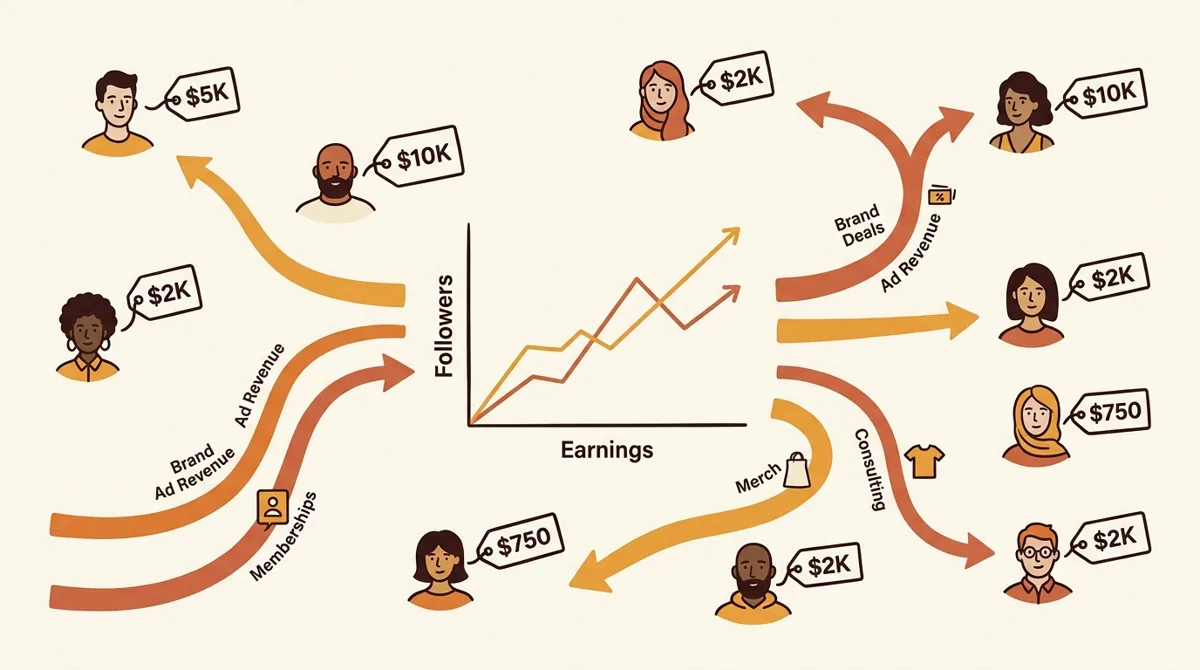
AI-assisted editorial illustration by CreaMate. Conceptual summary only; reported case-study figures remain in the chart and text above.
The money is never from platform payouts or reach. Every low-follower, high-income creator here sells UGC, affiliate commission, a service, or a high-ticket offer — income tied to conversion and trust, not to a view counter. The creators who earn well decided early that they were selling something a buyer pays for directly. Platform payouts, for context, run $10–100 a month at this size — the full breakdown is in how much money creators actually make.
The inflection point is stream #2 and #3. Nobody jumped to six figures on a single income line. Megan raised rates and added retainers. Matt runs sponsorships and has room for products. Kajabi's 2025 data backs the pattern: creators who packaged income across multiple offers earned 4.5x more than single-product creators at the same size (Kajabi). The second stream is where small income becomes a living.
The timeline is 12–24 months, not one viral week. Salha hit full-time in about a year. The six-figure cases compounded over one to two years of consistent, boring stacking. There is no example here of overnight — and the ones chasing overnight are the ones still earning $10 a month.
The cautionary read: do not model your plan on the outlier who blew up. Model it on Gigi and Tyler — small, niche, packaged, patient. The Devrim case is the reminder that a bare product with no distribution is a $2,539 year, not a business. Pick a path that pays for a skill or a conversion, then add the second one before you scale the first.
Turn these examples into your own numbers
The common enabler across every winning case is proof a buyer can verify — a niche, real engagement, past work, all checkable in one place. That is what let Gigi charge $500 instead of accepting $50, and what Tess was missing at $12. Make your stats and portfolio public and defensible, then pitch the path that fits your skill.
Start with the two fastest to a first dollar: how to become a UGC creator and how to get brand deals as a small creator. The case studies are not luck. They are a structure you can copy.
This is one chapter of the 1K–100K Creator Money Playbook. CreaMate is an AI co-pilot for short-form creators — hooks, covers, posting plans, and brand deals in one place — built to help small creators earn more, not work more.
FAQ
- How much do small creators actually make in 2026?
- It ranges from a few thousand a year to multiple six figures, and follower count barely predicts it. In the sourced examples below, a 13.5k-follower creator earns about $500 per packaged post while a 30k-subscriber newsletter clears multi-six-figures — because both sell something beyond reach.
- Do you need to go viral to make money as a creator?
- No. Not one of the high-income examples here comes from viral reach or platform payouts. Every low-follower, high-income case is built on UGC, affiliate, a service, or a high-ticket offer — income tied to trust and conversion, not view counts.
- What is the income inflection point for creators?
- Adding a second and third income stream. Single-stream creators stay small; the ones who stacked a service on top of content, or affiliate on top of a newsletter, are the ones clearing a living wage. Kajabi found packaged creators earn 4.5x more than single-product ones.
- How long does it take to make a full-time creator income?
- Usually 12–24 months. Salha Aziz went from zero to full-time UGC in about 12 months across 200+ brands; most of the six-figure examples here compounded over one to two years, not one viral month.