The Creator Media Kit That Wins Deals (Free Template)
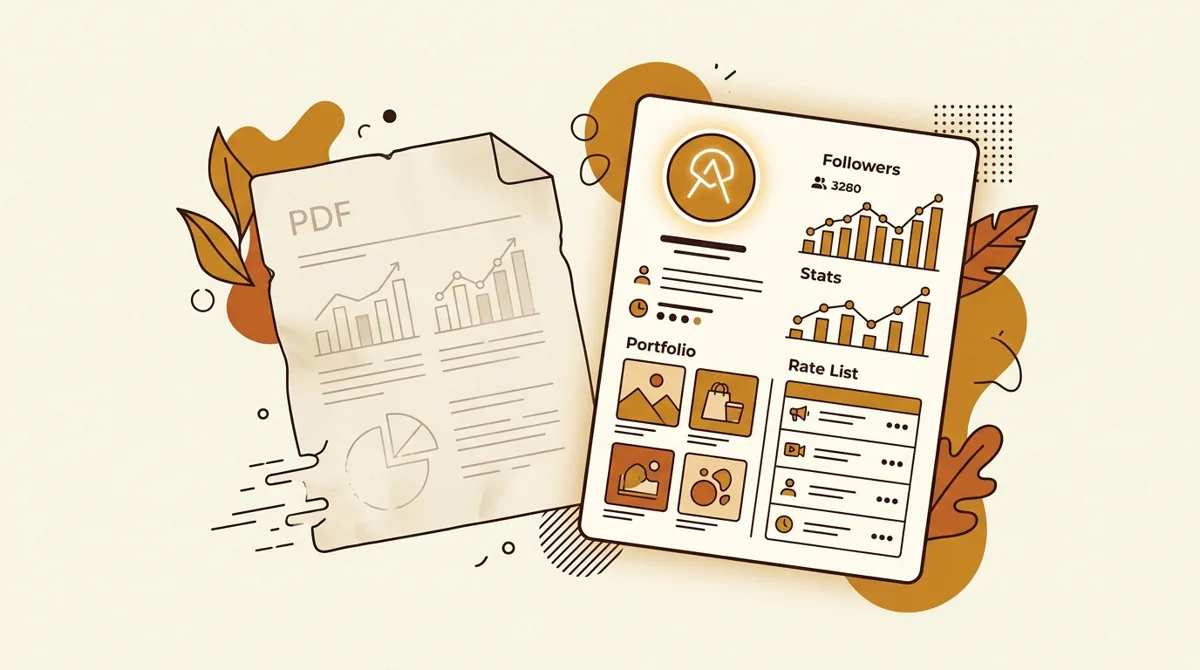
A media kit wins deals when a brand can see fit, price, and proof in under 30 seconds — which is why the kit that closes has exactly five modules and nothing else. Most creators either send a bloated 12-page PDF no one reads or a one-line DM with no numbers. Both lose. The version that gets a reply is a tight, verifiable snapshot: who you reach, what you charge, and evidence you deliver. Collabstr's 2026 medians put a sponsored TikTok near $200 (Collabstr 2026 Influencer Marketing Report), and the media kit is what moves a brand from "maybe" to that number.
Here are the five modules, how to structure your pricing, and why a live profile now out-performs the PDF that ruled 2020.
What are the five modules of a media kit that closes?
A closing media kit is not a design project. It is five answers a brand needs before it replies, in the order it needs them. Skip any one and the deal stalls on a question you could have pre-answered.
| Module | What goes in | Why brands care |
|---|---|---|
| 1. Positioning line | One sentence: who you reach and what you make | It answers "are you a fit?" in the first three seconds |
| 2. Verified stats | Per-platform followers, engagement rate, audience age and geo | Verified beats claimed — it is the difference between trust and doubt |
| 3. Package pricing | Single video, bundle, and retainer — not one lonely number | Packages anchor higher and pre-empt the "what do you charge?" email |
| 4. Proof | Top posts, a past-deal result, a short testimonial | It shows you deliver outcomes, not just reach |
| 5. Contact + CTA | Email, booking link, one clear next step | A brand ready to buy needs the path made obvious |
| Everything else | Long bios, mood boards, 12 slides of fluff | Red — it buries the four things that actually decide the deal |
Source: CreaMate 2026 media-kit teardown. Package-pricing medians via Collabstr 2026 influencer report; buyer-scan behavior and engagement-rate benchmarks via Kajabi State of Creator Commerce 2025.
Notice what is not on the list: a cover-letter essay, your life story, or a wall of logos you have no relationship with. The kit that closes is dense with the four things a brand actually decides on, and empty of everything it does not.
How should you structure package pricing?
The single biggest upgrade to most media kits is trading one number for a package menu. A lone "my rate is $200" gives a brand a yes-or-no. A three-option menu gives it a which-one — a far easier question, and one that usually settles higher.
A workable small-creator structure:
- Single deliverable — one video at roughly $220, your anchor price (Collabstr 2026 Influencer Marketing Report).
- Bundle — three videos at a modest discount, framed as a mini-campaign. This is where most deals land because it reads as better value while raising your total.
- Monthly retainer — a set number of posts per month for a flat fee, the option that turns a one-off into recurring income.
Show the packages; hold your exact floor for the negotiation. The menu does the anchoring so you do not have to argue from zero. If you are unsure where your numbers should sit, how much brand deals pay has the current bands by tier and platform.
Keep the package menu compact here, then send a dedicated influencer rate card when the buyer needs line-by-line deliverables, usage rights, add-ons, and a validity date.
For eligible YPP channels, the YouTube Creator Partnerships guide shows how to pair YouTube's native Media Kit and desired-rate fields with that cross-platform package menu.
Why a live profile beats a PDF
A PDF media kit has one fatal flaw: it is out of date the moment you send it. Your follower count moved, your best post changed, your engagement rate shifted — and the brand is reading a snapshot from three weeks ago. Worse, every number in a PDF is a claim the brand has to take on faith. A screenshot proves nothing.
A live profile fixes both. Stats update automatically, so the kit is never stale. And connected, verifiable per-platform numbers turn "trust me" into "check for yourself" — the single strongest trust signal a small creator can send. In a market where brands have been burned by inflated screenshots, verification is leverage. This is the whole argument in a creator profile that wins brand deals: the link is the media kit now, and the PDF is the fallback you export from it, not the other way around.
What not to put in a media kit
The cautionary case: the 12-slide "brand deck" — mood-boarded, gradient-heavy, and completely unread. It fails for three reasons.
- It hides the decision-makers. Fit, price, and proof are buried on slides 7 through 10, behind an about-me essay and a manifesto. The brand bounces before it reaches them.
- It fakes credibility. A wall of "as seen in" logos for brands you were never paid by reads as padding. One real result — "this post drove 1,400 clicks to a launch" — outweighs twenty logos you have no relationship with.
- It cannot be verified. Every stat is a screenshot, every screenshot is a claim, and a brand that has been burned once assumes the worst. Unverifiable numbers do not just fail to help; they actively raise suspicion.
The fix is subtraction. Cut the kit to the five modules, make every number checkable, and let the brand reach the decision in seconds instead of slides. A media kit is not where you impress a brand — it is where you remove every reason for it to say no.
The creators who close are not the ones with the prettiest deck. They are the ones whose kit answers fit, price, and proof before the brand has to ask — on a link that is true the day it is opened.
This is one chapter of the 1K–100K Creator Money Playbook. CreaMate is an AI co-pilot for short-form creators — hooks, covers, posting plans, and brand deals in one place — built to help small creators earn more, not work more.
FAQ
- What should a creator media kit include?
- Five modules: a one-line positioning statement, verified per-platform stats, package pricing, proof of past results, and a clear contact line. Brands skim for fit, price, and proof in under 30 seconds, so those must be visible first.
- How much should I charge on my media kit?
- Show packages, not a single number. A common small-creator structure runs one video at roughly $220, a three-video bundle at a discount, and a monthly retainer — Collabstr's 2026 medians put a sponsored TikTok near $200. Packages anchor brands higher than a lone rate.
- Do I need a PDF media kit in 2026?
- A live link beats a PDF. A PDF is out of date the day you send it, while a live profile updates its stats automatically and lets brands verify your numbers — the trust signal a static file can't give.
- How do I make a media kit with no big brand deals yet?
- Use proof you already have: your best-performing organic posts, engagement rate, audience demographics, and any gifted or affiliate work. Concrete results from small collaborations beat an empty 'as seen in' section every time.