Creator Taxes in 2026: What You Actually Owe
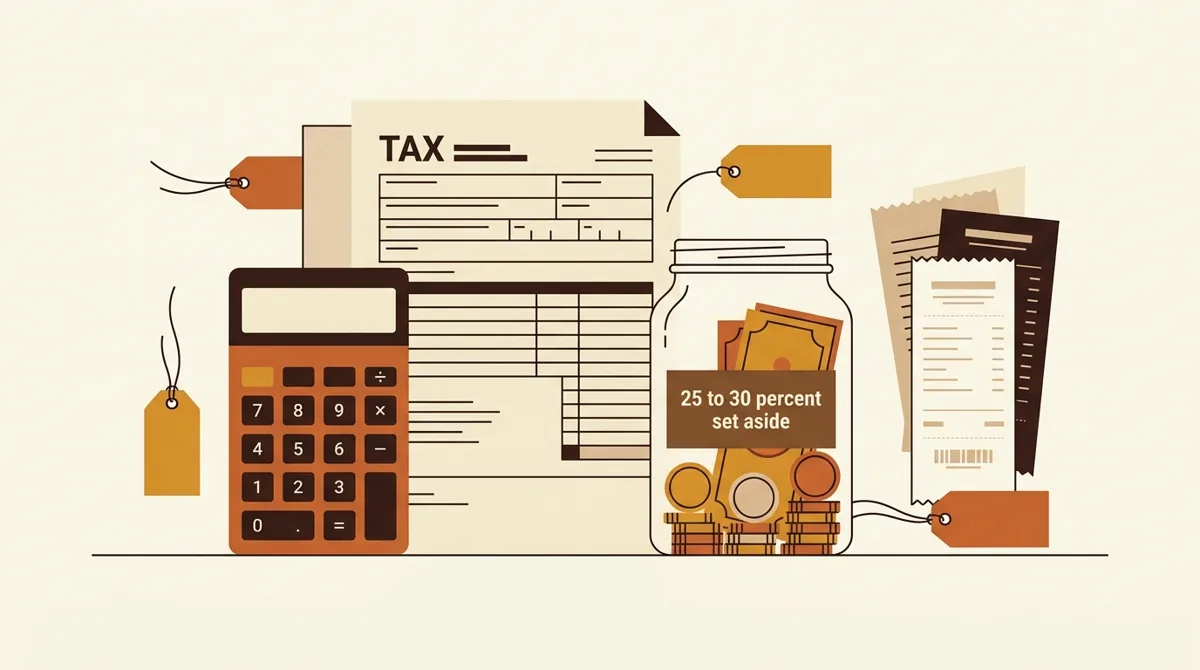
If you make money from content in the US, the honest headline is this: set aside 25–30% of every dollar you earn and you will rarely be surprised in April. You are generally self-employed when you run creator work as your own trade or business — which can mean regular income tax plus self-employment tax (IRS self-employment tax guide). This is general educational information for US-based creators, not personalized tax or legal advice — confirm your own numbers with a preparer or IRS.gov.
None of this is as scary as the surprise-bill stories make it sound. It is arithmetic you can run once and then mostly automate. Here is what you actually owe, and where the deductions are.
Why creators owe more than employees
When you have a normal job, your employer withholds income tax from every paycheck and pays half of your Social Security and Medicare for you. A creator has no employer doing any of that. To the IRS you are a sole proprietor running a business, so two things stack up:
- Income tax at your normal bracket, on your net profit.
- Self-employment (SE) tax is generally 15.3% — 12.4% Social Security plus 2.9% Medicare — and Schedule SE calculates the taxable amount from net earnings (IRS self-employment tax guide). The Social Security wage base changes by tax year, so use the current Schedule SE rather than a rounded figure copied from an older article.
You report the business on Schedule C (income minus expenses) and calculate SE tax on Schedule SE. The one piece of good news: you deduct half of your SE tax against your income tax, so the effective bite is lighter than 15.3% feels.
Do I owe tax if I never got a 1099-K?
Yes — and this trips up more small creators than anything else. A 1099-K is just a platform reporting your payouts; it does not decide whether you owe. For payment apps and online marketplaces, the current federal TPSO threshold is more than $20,000 and 200 transactions, though a platform may send the form below that threshold (IRS Form 1099-K guide). Whether or not a form arrives, income from goods or services still has to be reported.
That changes nothing about what you owe. Brand-deal payments, affiliate commissions, tips, digital-product sales, and UGC fees are all taxable income whether a form arrives or not. Track your own gross — do not wait for a platform to tell you.
Which creator expenses are actually deductible?
This is where the tax bill gets smaller, and where creators either overreach or leave money on the table. The rule is simple to state and easy to misapply: a business expense generally needs to be ordinary and necessary for the trade or business (IRS Publication 334). "I filmed in it" is not the test. Here is how the common categories fall.
| Expense | Deductible? | Notes |
|---|---|---|
| Camera / phone | Yes (business-use %) | Prorate if you also use it personally |
| Editing software / subscriptions | Yes | CapCut Pro, Adobe, scheduling tools |
| Home office | Yes, if exclusive + regular use | Simplified method: $5/sq ft up to 300 sq ft |
| Internet / phone bill | Yes (business %) | Deduct only the work-use share |
| Props / products to review | Usually yes | Must be used for content; keep receipts |
| Business meals | 50% | Needs a real business purpose and a record |
| Everyday clothes / makeup | No | Not deductible even if you film in them |
| Gym / personal fitness | Rarely | Personal benefit; hard to justify even for fitness creators |
Source: IRS Publication 334 and Schedule C instructions (https://www.irs.gov/publications/p334). General guidance, not tax advice.
The pattern: gear, software, and space you use to make the content are fair game, prorated honestly. Things you would buy anyway as a person — a haircut, a nice outfit, a gym membership — almost never qualify, no matter how central they feel to your brand. The clothing rule is strict: to be deductible, clothing has to be unsuitable for everyday wear, which rules out nearly everything a creator actually films in.
The creator who owed $4,000 they didn't have
The cautionary case: a creator lands their first real year, clears about $30,000 from brand deals and affiliate links, and spends most of it as it comes in. No form arrives from any platform, so they assume they're under the radar. April comes, they fill out Schedule C, and the software returns a bill of roughly $4,000 — most of it self-employment tax on income they never withheld against, plus an underpayment penalty for skipping quarterly payments.
Nothing here was avoidable after the fact. It was entirely avoidable before. Two habits prevent it:
- Move 25–30% of every payout into a separate savings account the day it lands. Treat it as money that was never yours. If you end the year having over-saved, that is a refund to yourself.
- Check whether estimated payments apply if you expect to owe $1,000+. Individuals generally need estimated payments when they expect to owe at least $1,000 after withholding and refundable credits, subject to the IRS safe-harbor tests and due dates (IRS estimated taxes).
For a sense of where these numbers land at different follower sizes, how much money creators actually make puts the income side in context.
How to run your creator taxes without a panic
You do not need an accountant to be organized; you need one system you actually follow. The minimum viable setup:
- A separate business bank account. Run every payout and expense through it. This single move does more for clean taxes than any app — it turns bookkeeping into reading one statement.
- A running expense log by category that matches Schedule C lines. A simple sheet is enough at this stage. Keep receipts for anything you'd struggle to explain in two years.
- A tax-savings account that gets 25–30% of each payout automatically.
- Quarterly reminders for estimated payments, if you clear the $1,000 threshold.
Do this and your April is a data-entry afternoon, not a crisis. Once the income and the products get more complex — selling courses, memberships, or downloads — the bookkeeping matters more, which is worth planning for as you sell digital products as a creator.
The tax system treats you as a business because you are one. That is not a punishment — it is the same status that lets you deduct the gear, the software, and the room you work in. Owe it knowingly, set the money aside as it comes, and the bill stops being a surprise.
This is one chapter of the 1K–100K Creator Money Playbook. CreaMate is an AI co-pilot for short-form creators — hooks, covers, posting plans, and brand deals in one place — built to help small creators earn more, not work more.
FAQ
- How much should a creator set aside for taxes?
- For most US creators, 25–30% of net income is a safe holdback. That covers federal income tax plus the 15.3% self-employment tax on your first roughly $176k of net earnings. Higher earners and high-tax states should lean toward 30–35%. This is general educational information, not personalized tax advice — confirm your own rate with a preparer or IRS.gov.
- Do I owe tax if I didn't get a 1099-K?
- Yes. Income is taxable whether or not a platform sends a form. The 1099-K threshold has bounced around and is back near $20,000 and 200 transactions for 2026 after the 2025 law change, so many small creators won't get one — but brand deals, tips, and affiliate income are all reportable regardless.
- What is self-employment tax and why do creators pay it?
- Self-employment tax is the 15.3% that covers Social Security (12.4%) and Medicare (2.9%). Employees split this with an employer; creators are both, so you pay the whole thing on net earnings. You do get to deduct half of it against income tax, which softens the hit.
- Do creators have to pay quarterly estimated taxes?
- If you expect to owe $1,000 or more for the year, the IRS wants estimated payments four times a year — roughly mid-April, June, September, and the following January. Skipping them can trigger an underpayment penalty even if you pay in full at filing.