Instagram Trial Reels: Test Hooks Before Posting

Instagram Trial Reels are best used as a controlled creative test: show one Reel to non-followers first, inspect the early response, and then decide whether the concept deserves wider distribution. Test one meaningful variable—hook, topic, format, or CTA—while keeping the rest stable. Read the first signal after about 24 hours, but do not pretend a Trial Reel is a laboratory-grade A/B test.
This guide is for creators and social teams that have several plausible Reel ideas but limited filming and posting capacity. Download the Trial Reels test log before you publish so every result leads to a decision.
Jump to: how Trial Reels work · what to test · clean experiment · 24/72-hour reads · decision rules
How Instagram Trial Reels work
Meta's official Trial Reels announcement says a creator can switch on Trial before sharing a Reel. The Reel is shown to non-followers first and appears alongside drafts for the creator. It does not normally appear to followers on the main profile grid or Reels tab unless the creator later shares it with everyone.
The separation is useful, but not perfect. Meta says followers may still encounter a trial if someone sends it to them or if they visit a page using the same audio, location, or filter. Treat a Trial Reel as a non-follower-first test, not a sealed audience experiment.
About 24 hours after sharing, the creator can see views, likes, comments, and shares, plus a comparison with previous trials. The creator can manually share with everyone. Meta also offers an option to let Instagram automatically share a trial that performs well, based on views during its first 72 hours. That is the platform mechanic; it is not a promise that every account receives the same audience or threshold.
| Test | Hold as stable as practical | Read first | Decision |
|---|---|---|---|
| Hook | Topic, body, format, length range | Views plus shares, comments, and fit | Keep the clearer opening |
| Topic | Creator, format, pacing, production level | Whether the right strangers respond | Build a cluster or move on |
| Format | Promise, topic, proof, approximate duration | Clarity and completion of the promise | Use the format for the next related idea |
| CTA | Video creative and value delivered | Shares or comments tied to that ask | Keep only the action that fits |
Source: Meta Trial Reels announcement, updated 2025-06-26 and reviewed 2026-08-18; test design is CreaMate editorial guidance.
Choose one variable to test
Hook test
Use the same core answer and production style, but change how the opening frames it. For a Reel about editing faster:
- direct benefit: “Cut your next talking-head edit in half with these three passes.”
- mistake: “Stop polishing the first cut before you remove these pauses.”
- demonstration: show the before-and-after timeline in frame one.
Use the hook formula guide to create distinct angles. Avoid changing the hook, body, length, music, and visual format in the same test; a larger difference may produce a winner, but it will not teach you which choice mattered.
Topic test
Keep the creator, pacing, and format consistent, then test different promises for the same audience. A freelance creator might compare “how to quote one UGC video” with “what paid usage means.” The useful question is not which topic gets the largest raw view count; it is which attracts people the account can continue helping.
Format test
Hold the promise steady and change the delivery: talking head, screen demonstration, voiceover B-roll, or a concise visual list. Use the Reels ideas generator to explore formats, then select one that can actually prove the claim. A generated format suggestion is raw material, not evidence.
CTA test
CTA experiments only make sense after the Reel delivers value. Ask for one action that fits the post: share a checklist, comment with a specific choice, or save a process for later. Do not stack “like, follow, comment, save, and share” at the end and then try to interpret the result.
Run a cleaner Trial Reels experiment
- Write the decision first. Example: “If the demonstration hook produces a stronger qualified response than my recent trials, I will use demonstration openings for the next three tutorials.”
- Choose one variable. Mark it in the test log; note what stays constant.
- Create a meaningful variant. Do not repeatedly upload an exact duplicate just to chase a different sample. Change the creative hypothesis, not only a tiny cosmetic detail.
- Publish as a Trial Reel. Turn on Trial before sharing and confirm it appears in your trials/drafts area.
- Record the 24-hour read. Save views, likes, comments, and shares that Instagram provides, plus a short quality note about who responded.
- Wait for the decision window. If you enabled automatic sharing, record what happened across the 72-hour view window Meta describes.
- Choose keep, revise, or stop. Convert the result into the next production action.
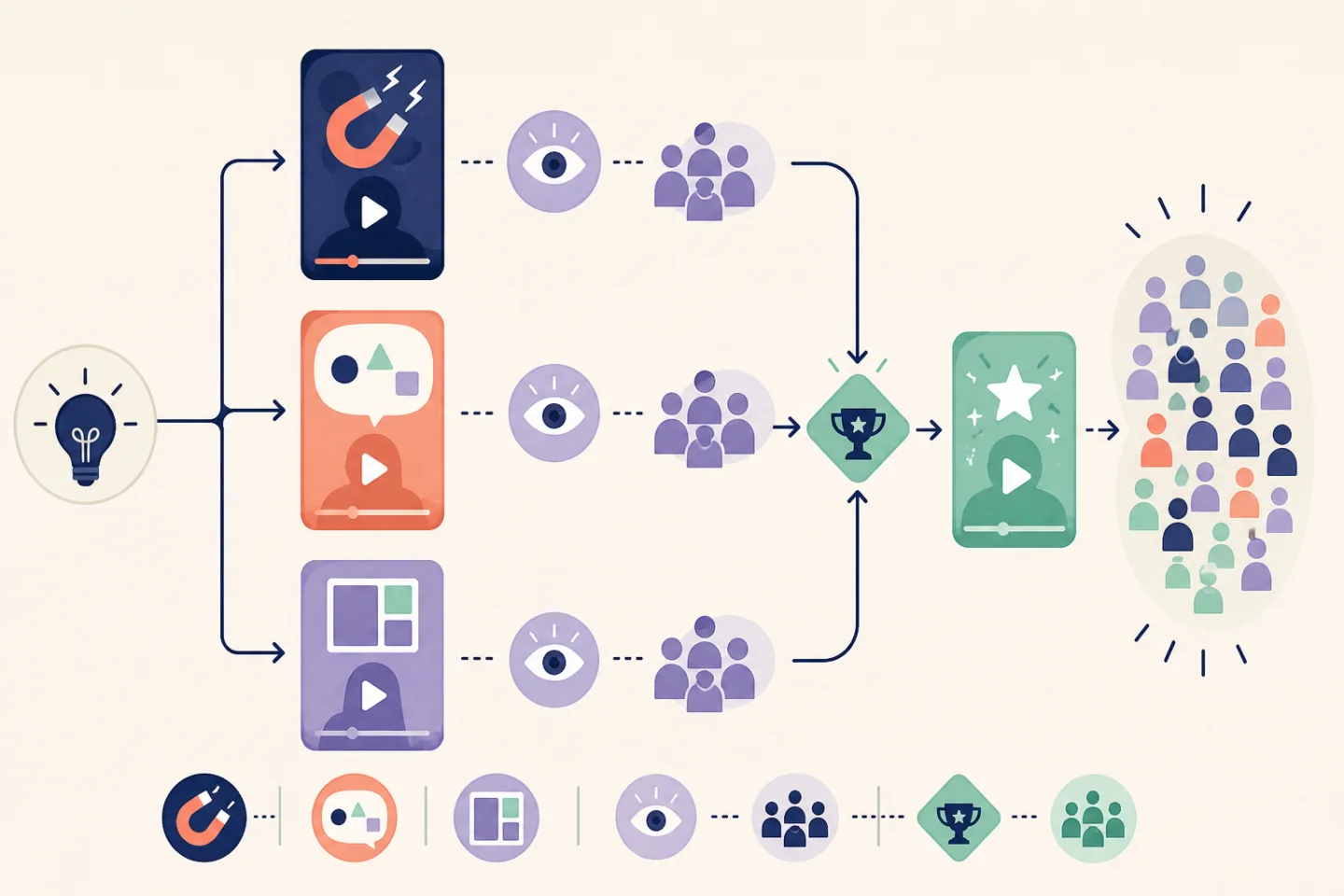
AI-assisted conceptual illustration by CreaMate. It does not depict Instagram's interface or exact metrics.
How to read the first 24 and 72 hours
Meta provides the time windows, but it does not provide a universal passing score. Read each layer differently:
- At about 24 hours: use the available views, likes, comments, shares, and comparison with earlier trials for an early directional read.
- Across 72 hours: if auto-share is enabled, this is the view window Instagram says it uses to decide whether to share the trial to followers.
- After wider sharing: judge whether the idea still works with your existing audience and whether it earns the profile actions or business outcome you wanted.
Compare trials with your own recent trials serving a similar audience. A topic with a tiny addressable audience may be strategically strong even if it cannot beat a broad entertainment post on raw views. Read comments for intent, shares for usefulness, and profile-level outcomes where your Insights make them available.
Trial Reels do not randomly split equal audiences, and Meta does not publish confidence intervals for them. Do not call a 5% difference “statistically significant.” The honest output is a directional creative decision: this hook earned a clearer response; test it again on a second topic.
Turn the result into the next creative decision
Use a three-way rule:
- Keep: the idea attracts the right non-followers and the response supports wider sharing. Share with everyone or reuse the winning structure on a related topic.
- Revise: the comments show interest but the hook, proof, pace, or CTA caused confusion. Change only the weakest element.
- Stop: the topic has poor audience fit or the answer cannot become credible enough to justify more production.
CreaMate is most useful before the test: turn one insight into several hook or script candidates, label the variable, and keep a record of what you actually shipped. It should reduce blank-page time, not automate judgment. Pair this guide with the 2026 Instagram growth guide and captions that earn saves so the winning Reel also has a clear post-level action.
What not to conclude from one Trial Reel
- “Non-followers dislike my account.” You tested one creative, not your entire positioning.
- “This is the perfect hook.” You have one directional result, not a universal law.
- “Followers cannot possibly see it.” Meta documents several paths where a follower may encounter a trial.
- “Automatic sharing means the Reel is objectively good.” It means Instagram's system chose to expand that trial under its current signals.
- “More variants always produce more learning.” Weakly differentiated or poorly logged variants create noise.
Begin with three experiments over one content cluster. Fill the downloadable Trial Reels log, state the decision before each upload, and carry only one learning into the next Reel.
Fact check: Trial toggle, non-follower-first distribution, possible follower exposure, approximately 24-hour metrics, manual sharing, and the 72-hour auto-share window were reviewed against Meta's official Trial Reels page on August 18, 2026. Availability and interface details can change.
FAQ
- What are Instagram Trial Reels?
- Trial Reels let eligible creators show a Reel to non-followers first, review early performance, and then choose whether to share it with everyone. A trial is not normally shown on your main profile grid or Reels tab until you share it more broadly.
- Can followers see a Trial Reel?
- Trial Reels are designed for non-followers first, but Meta says some followers may still encounter one through a direct message or on pages using the same audio, location, or filter. Treat the audience as follower-light, not perfectly isolated.
- How long should I wait before judging a Trial Reel?
- Meta says creators can see key engagement metrics about 24 hours after sharing. If auto-sharing is enabled, Instagram can use views from the first 72 hours to decide whether to share the Reel with followers. Use 24 hours for an early read and 72 hours for the auto-share window, not as universal success thresholds.
- Are Trial Reels a true A/B testing tool?
- No. Instagram does not describe Trial Reels as randomized, equal-audience split tests and does not publish statistical confidence. Run variants sequentially, change one meaningful variable at a time, and compare directionally with your own past trials.
- What should I test with Trial Reels?
- Test one of four useful variables: the opening hook, the topic or promise, the content format, or the call to action. Keep the rest of the concept as stable as practical so the result can inform the next creative decision.