The Creator Profile That Wins Brand Deals (and Why Media Kit PDFs Lose Them)
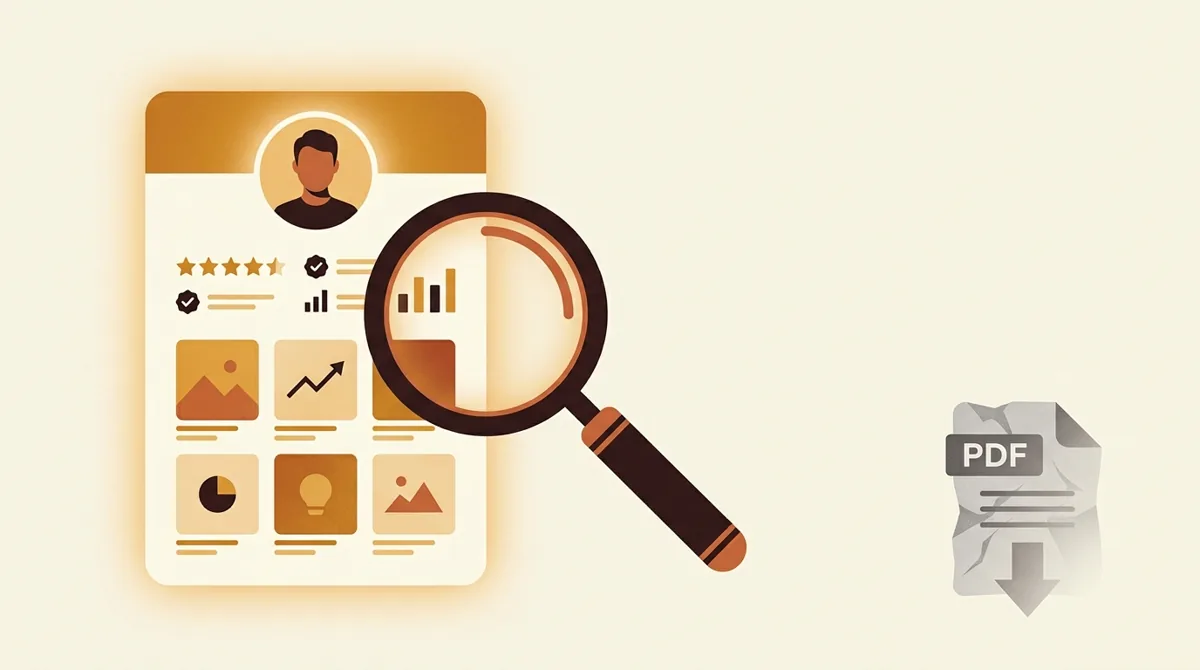
Brands decide whether to work with you before they ever reply — a silent screen of your niche, your real engagement, and your past work that happens on a phone in under three minutes. A creator profile — a single live URL with verifiable per-platform stats, portfolio, and a contact path — is built to pass that screen. A PDF media kit, the tool most creators still use, is built to fail it.
That's the argument of this piece. Here's the evidence, stage by stage of a real deal.
| Deal stage | PDF media kit | Live creator profile |
|---|---|---|
| Discovery | An attachment to request, download, and open | One URL, one tap from bio, pitch, or DM |
| Vetting | Screenshots — take-my-word numbers | Live stats a brand can cross-check against your platforms |
| Negotiation | Defending a screenshot | A rate priced from verifiable data |
| Closing | No contact loop — interest decays | Portfolio, testimonials, and a contact CTA in one view |
| Repeat business | Buried in an inbox | The same link, still current six months later |
Source: deal stages as described in this guide.
How do brands actually vet creators?
When your pitch lands — or when a brand finds you first — someone screens you before anything is written back. The screen covers four things, in roughly this order:
- Niche fit. Does your content sit next to their product naturally? A close call goes to the creator whose positioning is stated, not inferred.
- Real engagement. Follower count gets a glance; the ratio gets scrutiny. A 40k account at 0.8% engagement reads as bought or dead. (Know your number before they do — the engagement rate calculator takes thirty seconds.)
- Past brand work. Have you delivered sponsored content before, and did it look like content or like an ad break?
- Professionalism signals. A clean asset, current numbers, a clear way to respond. Sloppy materials predict sloppy delivery, and brands screen on that proxy constantly.
The brutal part: most rejections happen here, silently. You don't get a "no" — you get nothing, and never learn which check you failed. So the entire game is making these four answers instantly visible and instantly believable.
Why do PDF media kits lose deals?
A media kit — the traditional one-to-three-page PDF — was the right tool when deals moved by email and desktop. It has four structural failure modes in 2026:
- It's stale within weeks. Your stats move every day; your PDF doesn't. Every brand knows the numbers were true only on export day, so they discount everything in it — and an outdated kit actively signals carelessness.
- It's unverifiable. Screenshots of analytics prove nothing in an era when anyone can edit a number in five minutes. Unverifiable claims force the brand to re-do the vetting themselves, and many just move to the next creator instead.
- It's friction on mobile. Brand-side vetting happens on phones, between meetings. A 12MB attachment that needs downloading and pinch-zooming loses to any competitor who sent a link that just opens.
- It has no contact loop. A PDF ends. There's no button, no next step — the interested brand has to scroll back through email to figure out how to respond, and interest decays every hour that takes.
None of this means the content of a media kit is wrong — the stats, work samples, and rates still matter, and our media kit guide covers what to include. The failure is the container.
What does a live creator profile do at each deal stage?
A live profile isn't a prettier media kit; it works differently at every stage of a deal.
Discovery. One URL goes in your bio, your pitch, your marketplace conversations, your email signature. A brand that encounters you anywhere is one tap from the full picture — no attachment, no request, no waiting.
Vetting. Your per-platform stats are live and cross-checkable: a brand can open your TikTok next to your profile and watch the numbers agree. That agreement is the whole trust mechanism — verification the brand performs itself beats any claim you could make.
Negotiation. This is the underrated stage. When your numbers are verified, your rate is defensible: "my rate is $X, and here's the live engagement and audience data it's priced from" is a fundamentally different conversation than defending a screenshot. You negotiate from evidence, not vibes — and evidence is what stops the reflexive lowball. Pair the profile with the brand deal rate calculator so the number itself is priced from data too.
Closing. The last-mile doubt in every deal is risk: will this creator actually deliver? A portfolio of past brand work plus testimonials from previous partners answers it. Risk reduction closes deals that enthusiasm can't.
Repeat business. A PDF dies in an inbox; a URL keeps working. Six months after a campaign, when that brand manager plans the next quarter — or moves to a new company — your link still opens, still current, still selling you. Repeat and referral deals are the compounding asset of a creator business, and only a live page compounds.
PDF media kit vs live creator profile
| Dimension | PDF media kit | Live creator profile |
|---|---|---|
| Stat freshness | Frozen at export; stale in weeks | Current every time it's opened |
| Verifiability | Screenshots, take-my-word | Cross-checkable against live platforms |
| Mobile experience | Download, open, pinch-zoom | Opens like a web page, instantly |
| Contact loop | None — dead end | Built-in contact CTA |
| Sharing | Attachment per email, versions drift | One URL, always the latest version |
| After the campaign | Buried in an inbox | Keeps selling you at the same link |
What should you put on a creator profile?
Seven elements, in the order a brand reads them:
- A tagline — one line: who you reach and what you make. "Budget meal prep for students, 60-second recipes" beats any bio paragraph.
- Niche tags — the two-to-four categories you want to be matched on.
- Per-platform stats — followers, average views, engagement rate, per platform. Lead with engagement.
- An audience snapshot — age, gender split, top locations. This is what campaign managers paste into their brief.
- 3-5 featured works — your best performers plus past brand collaborations, with results where you have them. Five strong pieces beat twenty mixed ones.
- Testimonials — even one line from one past partner shifts perceived risk more than anything else on the page.
- Rates-on-request and a contact CTA — signal that you're priced and reachable; keep exact numbers for the conversation, where scope and usage can be negotiated properly. Set those numbers with the free creator tools rather than guessing.
Every CreaMate account includes exactly this: a public creator profile at creamate.ai/u/yourhandle — a live creator card with per-platform stats, niche tags, portfolio, audience snapshot, and a contact CTA. Create yours free; it takes minutes and comes with 2,000 credits for the writing tools.
When does a PDF still make sense?
Honest answer: sometimes. Agency-run RFPs and some corporate procurement processes require attachments — their intake systems literally have an upload field, and a URL won't fit in it. Larger campaigns occasionally want a custom one-pager tailored to the specific brief. Keep a lightweight PDF for those cases and put your profile URL on its first page, so even the attachment routes readers to the live version.
For everything else — the pitch DMs, the bio link, the inbound inquiry, the brand deals you're chasing as a small creator — the link wins. Brands vet silently, on mobile, in minutes. Give them a page that's current, checkable, and one tap from "let's talk", and you'll pass screens you never knew you were failing.
CreaMate is an AI co-pilot for short-form creators (TikTok/Reels/Shorts) that turns one topic into hooks, scripts, hashtags and cover briefs, and helps small creators price and land brand deals.
FAQ
- Do creators need a media kit or a profile link?
- In 2026, the default should be a live profile link — one URL with current, verifiable per-platform stats, portfolio, and a contact CTA — because brands vet on mobile in minutes and distrust static screenshots. Keep a PDF only as a fallback for agency RFPs that require attachments.
- What should a creator profile include?
- A one-line tagline stating your niche and audience, niche tags, per-platform stats with engagement rate, an audience snapshot, three to five featured works including past brand collaborations, testimonials, a rates-on-request note, and a clear contact CTA. Everything a brand needs to say yes on one page.
- How do brands vet creators before replying to a pitch?
- They check four things silently: whether your niche fits the campaign, whether your engagement is real relative to your follower count, whether you've done brand work before, and whether you communicate professionally. Most rejections happen in this screen, before any reply is sent.
- Why do PDF media kits fail?
- Four structural reasons: stats go stale within weeks, screenshots can't be verified against live accounts, PDFs are friction to open on mobile where most vetting happens, and a static file has no contact loop — the deal dies quietly at the last step.
- Does a creator profile actually help you charge more?
- Yes, because negotiation runs on evidence. When a brand can cross-check your live stats against your platforms, your quoted rate reads as priced-from-data rather than hopeful, and pushback drops. Verified numbers are what make a rate defensible.
- Is a Linktree the same as a creator profile?
- No. A link-in-bio page is a menu of destinations; a creator profile is a sales page with stats, portfolio, testimonials, and a contact CTA in one view. Brands can't vet you from a list of links — many creators put their creator profile as the first link on their Linktree.