The $5,000/Month Creator Roadmap (12–24 Months)
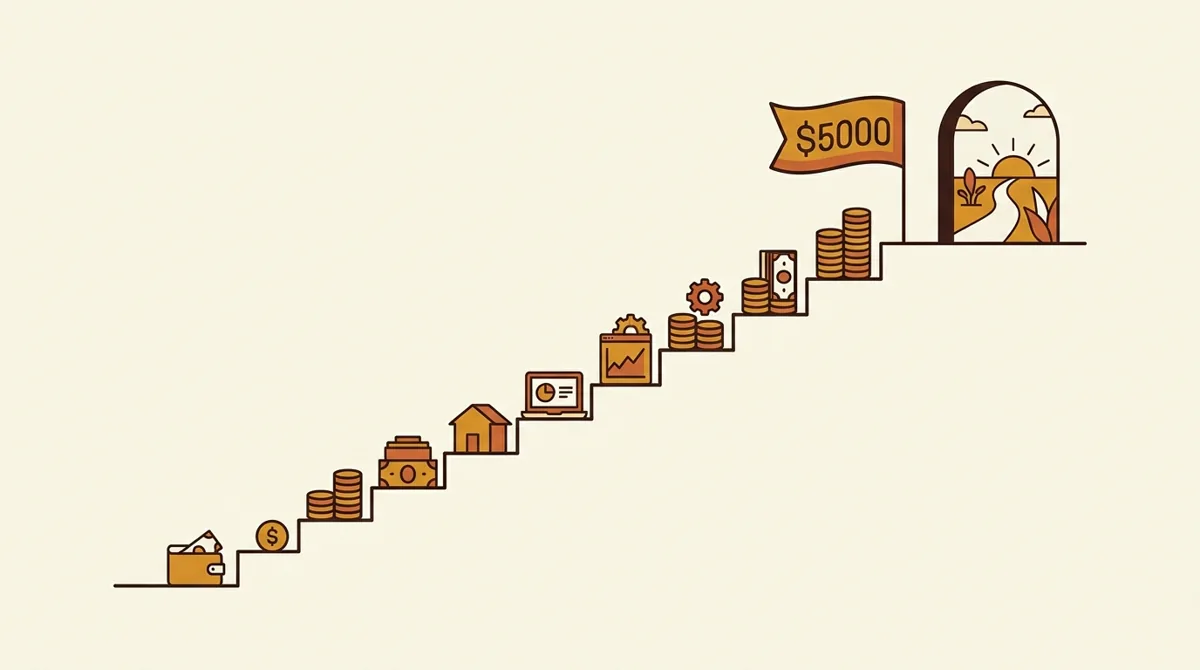
A full-time creator income of about $5,000 a month is reachable for a small creator, but almost never in under a year and almost never from a single income stream. The realistic path is 12–24 months of stacking — UGC, then affiliate, then retainers, then a product — where four modest lines add up to a paycheck. Salha Aziz hit full-time UGC in roughly 12 months; most six-figure creators compounded over one to two years, not one viral week (Collabstr).
Here is the month-by-month ladder, the streams you stack at each rung, and the one rule for when it is safe to quit your job.
What does the road to $5,000 a month actually look like?
It looks like a staircase, not a rocket. Each step adds an income stream on top of the last while the earlier ones keep running. The numbers below are a realistic composite from creator case data, not a promise — some people move faster, many move slower, and a few stall on a rung for months before the next one clicks.
- Month 1–2First $500
UGC videos plus one affiliate stream — proof a buyer will pay you.
- Month 3–5$1,000–1,500
Raise UGC rates, add a second affiliate program or TikTok Shop.
- Month 6–9$2,000–3,000
Land one or two monthly retainer clients for recurring, predictable income.
- Month 10–15$3,500–4,500
Add a low-ticket product or template and stabilize retainers.
- Month 12–24$5,000/mo
Four stacked streams covering your salary — the quit-your-job zone.
Source: CreaMate Playbook composite, 2026. Milestone timing from Business Insider creator profiles, Collabstr 2026 (Salha Aziz ~12 months to full-time UGC), and Kajabi State of Creator Commerce 2025 (packaged creators earn 4.5x single-stream). Illustrative pace, not a guarantee.
Notice that no single step carries the whole load. By the time you reach $5,000, roughly a quarter comes from each stream — which is exactly what makes the income survivable when one line dips.
Why stacking beats maxing one stream
The instinct is to pick the highest-paying stream and pour everything into it. That is how creators build a fragile income: one algorithm change, one lost client, one paused affiliate program, and the whole thing collapses. Stacking is slower but sturdier. Kajabi's 2025 data found creators who packaged income across multiple offers earned 4.5x more than single-product creators at the same size (Kajabi State of Creator Commerce 2025). Diversification is not just safety — it is the multiplier.
The four streams also feed each other. UGC work proves you can shoot converting video, which makes brands offer retainers. A retainer client's product becomes an affiliate line. Your affiliate audience becomes buyers for your own template or preset. Each stream lowers the cost of starting the next, which is why the ladder accelerates in the back half even though the early rungs feel slow.
The month-by-month streams, rung by rung
Months 1–2, the first $500. This is the hardest rung, because it is the one where you have no proof. Start with UGC — filming product videos brands run as ads, where your follower count is irrelevant — plus one affiliate stream in a niche you already post in. The goal is not the money; it is the first buyer. Once someone pays you once, everything after is repetition. The concrete routes are in how to make $1,000 a month as a creator.
Months 3–5, $1,000–1,500. Now you raise rates. Most beginners underprice badly — the fix is charging for a packaged deliverable, not a single post. Add a second affiliate program or TikTok Shop so more of your content converts. This rung is mostly about pricing confidence, which is information, not talent.
Months 6–9, $2,000–3,000. The inflection point: retainers. A retainer client who pays a fixed monthly fee turns lumpy project income into a predictable floor you can plan around. One or two retainers at $800–1,200 each changes the entire feel of the income — you stop waking up to zero.
Months 10–15, $3,500–4,500. Add a product you own: a template, preset pack, mini-course, or paid community. It is the highest-margin stream and the one that scales without your time. It also usually earns the least at first — the Gumroad floor is real, so keep it as the fourth stream, not the first bet.
Months 12–24, $5,000. Four streams, each carrying a share. This is the zone where quitting becomes a real question — which is exactly where most people make their worst decision.
When can I actually quit my job?
Here is the sober rule: quit when creator income has covered at least 80% of your salary for six consecutive months, and you have three-plus months of expenses saved. Not one good month. Not a projection. Six consecutive months, because creator income is lumpy and a single spike tells you almost nothing about the floor.
The reason for the rule is the most common regret in this whole game. Creators see one $6,000 month, hand in their notice, and discover the next month is $2,100 because a retainer ended and an affiliate program paused. Now they are full-time on an income that cannot cover rent, doing their most anxious work at the worst possible time. Income variance is the enemy, and the six-month rule exists to prove the floor is real before you bet your rent on it.
The cautionary case: the one good month that wasn't a floor
The reverse pattern to study. A creator strings together a strong month — a big UGC project landed, an affiliate promo popped, a video overperformed — and reads it as arrival. They quit the day job on that single data point. The problem is that the month was a ceiling, not a floor: the big project doesn't repeat, the promo ends, and the average was never $5,000, it was $2,800 with one lucky spike. Six months later they are back to job-hunting, having burned savings and momentum both.
The opposite failure is just as real — the creator so afraid of variance they never leave, working two full-time jobs at once until the creator side burns out from exhaustion rather than lack of income. The rule threads both: enough consecutive months to prove the floor, enough savings to absorb a bad quarter, and a decision made on the average, not the peak. For the fuller picture of what these incomes look like across real creators, nine sourced income examples shows how few of them came from a single stream — and how many took the full two years.
This is one chapter of the 1K–100K Creator Money Playbook. CreaMate is an AI co-pilot for short-form creators — hooks, covers, posting plans, and brand deals in one place — built to help small creators earn more, not work more.
FAQ
- How long does it take to make $5,000 a month as a creator?
- For most people who make it, 12 to 24 months of consistent stacking — not one viral month. Salha Aziz reached full-time UGC in about 12 months across 200+ brands; six-figure cases usually compounded over one to two years, not a single hit.
- How do creators build a full-time income?
- By stacking streams, not maxing one. A living creator income is usually UGC plus affiliate plus retainers plus a product — four smaller lines that add up to $5,000, each cushioning the others. Single-stream creators stay small; Kajabi found packaged creators earn 4.5x more.
- When should I quit my job to go full-time as a creator?
- A sober rule: when creator income has covered at least 80% of your salary for six consecutive months, with three-plus months of expenses saved. One good month is not a signal — income is lumpy, and the people who quit on a spike usually regret it.
- What is a realistic first milestone for a new creator?
- Your first $500 a month, usually reachable in the first one to two months through UGC plus a single affiliate stream. It is small on purpose: it proves a buyer will pay you, which is the hardest and most important step to clear.