How to Negotiate Brand Deals as an Influencer (Playbook)
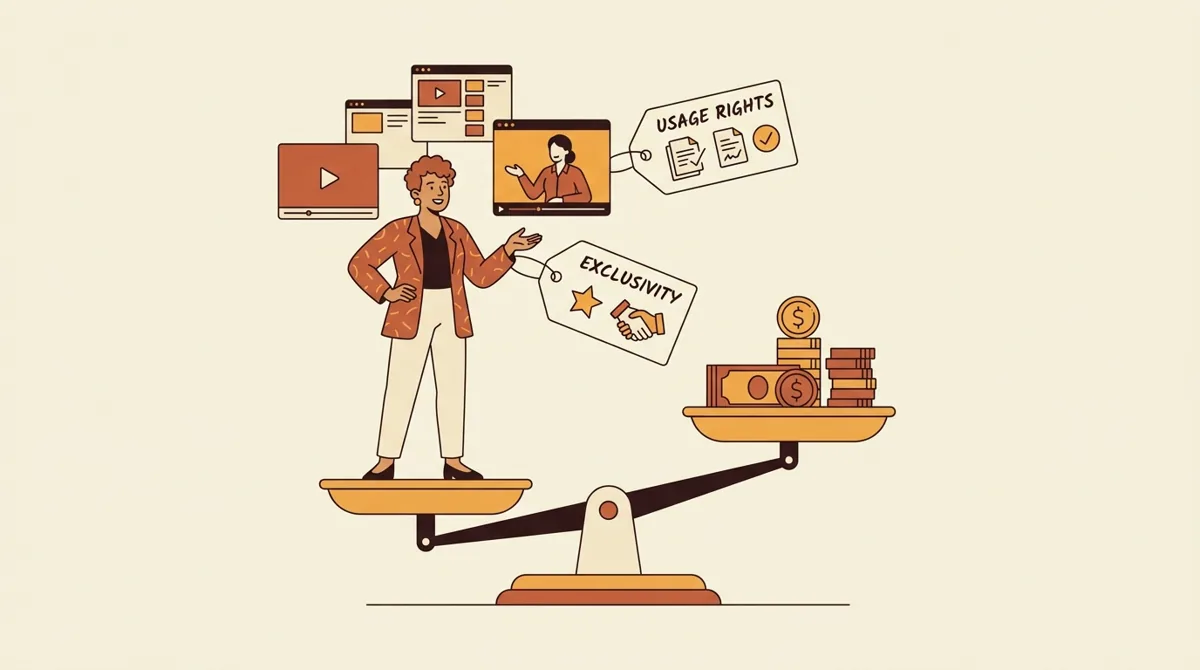
To negotiate brand deals as an influencer, start from one rule: never take the first offer. Brand reps build negotiation room into every opening number and expect a counter — creators who ask questions first, then counter 30–50% higher with a reason attached, routinely close 20–40% above the initial offer. The bigger unlock is negotiating total deal value, not just the fee: usage rights, exclusivity, raw files, and rush turnaround are all separate paid line items.
Here's the playbook, in the order a real negotiation unfolds. (New to how deals work at all? Start with what a brand deal is and the full TikTok brand deals guide.)
| Lever | Typical value | When it applies |
|---|---|---|
| Usage rights (ads, brand channels) | +20–50% per usage window | Brand runs your content as ads or reposts it |
| Exclusivity (30–90 days) | +20–30% | You give up competitor deals for the term |
| Raw file delivery | +15–30% | Raw footage is a separate license from the post |
| Rush turnaround (under 7 days) | +25–50% | Launch-week deadlines carry a rush fee |
| Extra revision rounds | Cap at 2, then per round | Bill further edits individually |
| Payment terms | 50% upfront or net-15 | First collaborations: half on signing |
Source: lever values as covered in this guide (2026 market rates).
Why should you never take the first offer?
Three reasons, all structural:
- The first number is an opening position. The rep's job is to land campaigns under budget. Their first offer is where they'd love to close, not where they can.
- Negotiating is expected. Reps deal with agencies all day; a counter reads as normal professional behavior, not greed. What actually reads as amateur is instant acceptance — it signals you didn't know your value.
- Accepting fast sets your ceiling. The rate you take today is the reference point for every future campaign with that brand.
The fear — "if I counter, they'll vanish" — almost never plays out. A brand that emails you has already decided you're worth budget. A polite counter with a rationale either gets a yes, a middle, or a "that's our max," and all three are fine outcomes.
Get curious before you counter
The biggest negotiation mistake isn't countering too high — it's countering before you understand the deal. When an offer lands, reply with questions instead of a number:
- "What deliverables are you picturing — how many videos, what length, which platforms?"
- "Will you want to use the content in paid ads or on your own channels?"
- "Is there an exclusivity window where I can't work with similar brands?"
- "What's the timeline, and how many rounds of revisions?"
- "What does success look like for you on this campaign?"
Every answer either raises the price (they want ad usage — that's a licensed add-on) or gives you leverage (a launch-week deadline means rush fees are on the table). You also come across as someone who's done this before, which itself moves the offer up. Only after scope is clear should you price it — with the brand deal rate calculator so your counter starts from a defensible figure, not a feeling.
Negotiate total deal value, not just the fee
Amateurs haggle the fee. Professionals reprice the package. These are the levers and what they're worth at 2026 market rates:
| Lever | Typical value | The line to use |
|---|---|---|
| Usage rights (ads, brand channels) | +20–50% per usage window | "Organic post is $X; ad usage for 60 days is +$Y" |
| Exclusivity (30–90 days) | +20–30% | "Blocking competitor deals has a cost — here's the add-on" |
| Raw file delivery | +15–30% | "Raw footage is a separate license from the edited post" |
| Rush turnaround (under 7 days) | +25–50% | "I can hit that date with a rush fee of $Y" |
| Extra revision rounds | Cap at 2, then hourly | "Two rounds included; further edits at $X each" |
| Payment terms | 50% upfront or net-15 | "For first collaborations I take 50% on signing" |
Notice what this does to a "we only have $500" conversation: fine — $500 buys the organic post. Ad usage, exclusivity, and raw files come off the table or get their own budget line. You've stopped negotiating against yourself and started scoping.
If it's your first time putting numbers to any of this, how to price your first brand deal builds the base rate the levers stack onto.
The counter-anchor script
Once scope is clear and their number is low, here's the shape of a counter that works:
Thanks for sharing the budget — excited about this one. Based on the scope (one 45s video plus ad usage for 60 days), my rate for this package is $X. That reflects my engagement rate of Y% — about double the average for accounts my size — and the usage license. If $Z is a hard ceiling, we could drop the ad usage and do the organic post alone at that level. How does that land?
Why this structure works: it anchors above their number, attaches a reason (your engagement rate and the scope), and offers a scope-reduced path to their budget instead of a discount. You never cut price without cutting scope — that's the whole discipline. Before you cite your engagement rate, verify it with the engagement rate calculator; quoting a number you can't back up is worse than quoting none.
Why creators with an agent earn more
Here's the uncomfortable pattern: the same creator, same audience, same content earns 20–50% more the day an agency starts negotiating for them. Not because the manager has magic contacts — because of three things creators negotiating alone struggle with:
- No emotion in the room. An agent isn't anxious the deal will vanish, so they don't fold at the first "that's above budget."
- Market-rate knowledge. They've seen fifty comparable deals this quarter and know what this brand pays other creators.
- Third-party framing. "Her rate is $800" lands differently than "I was hoping for maybe $800?"
Most creators under 100k followers can't get a manager — agencies take a cut that only makes sense at scale. This is exactly the gap CreaMate's AI agent covers: it can act as your agent in deal conversations, drafting the questions, the counters, and the walk-away lines at market rates, without the emotional wobble — and without taking a percentage. The leverage side is handled by your live profile: a counter built on verified numbers (creamate.ai/u/yourhandle shows your per-platform stats, engagement, and past brand work, pulled live) is credible in a way a self-reported screenshot never is. The rep can check your claim mid-negotiation and watch it hold up. Set up your free profile and AI agent before your next offer lands.
How do you walk away professionally?
Sometimes the budget genuinely isn't there. Walking away well costs you nothing and often pays later:
Totally understand — sounds like the budget and my rates aren't aligned for this one. I'd love to stay on your radar for future campaigns with more room. Keeping the door open on my side.
No lectures about exposure, no resentment. Reps change brands, budgets reset quarterly, and the creator who declined gracefully is the first name they remember with a bigger budget. Walking away is also the strongest negotiation signal there is — some "final offers" improve within a week of a polite no.
The deals you don't take define your rate as much as the ones you do.
CreaMate is an AI co-pilot for short-form creators (TikTok/Reels/Shorts) that turns one topic into hooks, scripts, hashtags and cover briefs, and helps small creators price, land, and negotiate brand deals.
FAQ
- Should you ever accept a brand's first offer?
- Almost never. First offers are opening positions with negotiation room built in — brand reps expect a counter, and creator surveys suggest most first offers sit 20–40% below the available budget. A professional counter rarely loses a deal that was real.
- How much should I counter on a brand deal offer?
- A common anchor is 30–50% above their offer, justified with your engagement rate and scope. If they offered $300, countering at $400–$450 with a one-line rationale is normal. The worst realistic outcome is meeting in the middle.
- What should I negotiate besides the fee?
- Usage rights (typically +20–50%), exclusivity (+20–30%), raw file delivery, rush turnaround, payment terms, and the number of revision rounds. Total deal value across these levers usually moves more than the fee itself.
- Why do creators with agents or managers earn more?
- Agencies routinely negotiate 20–50% higher rates because they remove emotion from the conversation and know current market rates. The brand isn't offering more because the creator got better — the negotiator did. AI agents now play this role for creators without a manager.
- When should you walk away from a brand deal?
- When the budget stays below your floor after negotiation, when they demand perpetual usage rights without paying for them, or when payment terms are vague. Decline politely and leave the door open — brands remember professional creators, and budgets change.