What Is Engagement Rate? Formula and Worked Example
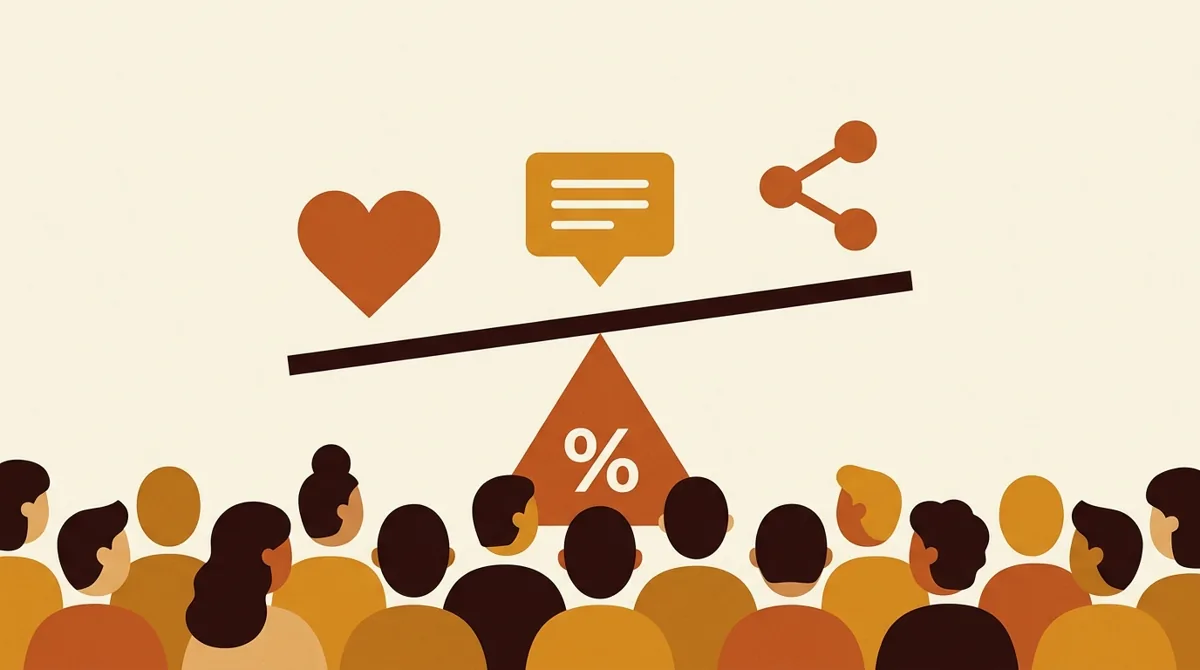
Engagement rate is the percentage of your audience that interacts with a piece of content, calculated as (likes + comments + shares + saves) ÷ followers × 100. On TikTok in 2026, per commonly cited industry benchmarks, 3-9% by followers is average and 10%+ is excellent. It measures how compelling your content is, not just how many people it reached.
Brands care about engagement rate more than follower count, because it shows whether an audience actually responds. A creator with 20,000 engaged followers often outperforms one with 200,000 passive ones.
| Benchmark | ER by followers | Verdict |
|---|---|---|
| TikTok — average | 3–9% | Normal — keep testing |
| TikTok — brands take notice | ~5%+ | Ready to pitch |
| TikTok — excellent | 10%+ | Lead your media kit with it |
| Other platforms — average | 1–3% | Normal — keep testing |
| Other platforms — excellent | 6%+ | Well above the bar |
| Worked example (10k followers) | 8% | Healthy — 12.3% by reach |
Source: benchmarks as stated in this guide (commonly cited industry figures, 2026).
How do you calculate engagement rate?
There are two common versions. The one you use depends on whether you measure against reach or followers.
Engagement rate by reach Engagement Rate = (Total Engagements ÷ Reach) × 100
Engagement rate by followers Engagement Rate = (Total Engagements ÷ Followers) × 100
Total engagements = likes + comments + shares + saves (and sometimes clicks).
By reach is the most accurate for a single post, because it compares interactions to the people who actually saw it. By followers is the most common in brand-deal conversations, since it's easy to calculate from public numbers.
What does a worked example look like?
Say you have 10,000 followers and you post a Reel that gets:
- 600 likes
- 80 comments
- 45 shares
- 75 saves
Total engagements = 600 + 80 + 45 + 75 = 800
Engagement rate by followers = (800 ÷ 10,000) × 100 = 8%
Now say that same Reel reached 6,500 accounts. Engagement rate by reach = (800 ÷ 6,500) × 100 = 12.3%.
Both are healthy. For context, in 2026 an engagement rate by followers above roughly 3-6% is generally considered strong on most platforms — on TikTok specifically, 3-9% is average and 10%+ is excellent — though it varies by niche and follower size. You can skip the math and run your numbers through the engagement rate calculator — it's free, needs no sign-up, and gives you both versions instantly.
Why does engagement rate matter for your pay?
When you pitch a brand, your engagement rate is a key part of your rate. Two creators with the same follower count can command very different prices if one engages 8% of their audience and the other engages 1%. On TikTok in 2026, brands typically start paying real attention from around 5%. A high rate signals an audience that actually acts on what you say — which is exactly what a sponsor is paying for.
That's why your media kit should lead with engagement rate, not just reach. Brands verify the number during vetting — usually by recalculating it from your recent posts — and a live creator profile (creamate.ai/u/yourhandle) shows your per-platform engagement rate verifiably instead of as a screenshot; see the creator profile that wins brand deals. Once you know your rate, you can plug it into the brand deal rate calculator to estimate fair pricing.
Which mistakes skew your engagement rate?
- Mixing the two formulas. Reach-based and follower-based numbers aren't comparable. Always say which one you mean.
- Forgetting saves and shares. On many platforms, saves and shares carry more weight than likes. Leaving them out understates your real engagement.
- Averaging across years. Old posts drag your number down. Calculate over your last 9-12 posts for an accurate current picture.
- Reporting one viral post. A single outlier makes your rate look better than your norm. Brands check averages.
FAQ
What's a good engagement rate? It depends on platform and size. On TikTok in 2026, 3-9% by followers is average, 10%+ is excellent, and brands start paying attention from around 5%; on most other platforms, 1-3% is average and above 6% is excellent. Smaller accounts usually post higher rates than large ones.
Should I use reach or followers in the formula? Use reach for the most accurate read on a single post. Use followers when comparing creators or pitching brands, since follower counts are public and consistent.
Do likes count more than comments? Comments and shares usually signal stronger interest than likes, and many algorithms treat them that way. All count as engagement, but weight your strategy toward the deeper signals.
Why is my engagement rate dropping as I grow? This is normal. Larger audiences are less uniformly interested, so the percentage that engages naturally falls. Watch the trend, not just the number — if the slide is steep, sharper openings lift comments and shares, so test a few with the TikTok hook generator — and explore more free tools to track it.
CreaMate is an AI co-pilot for short-form creators (TikTok/Reels/Shorts) that turns one topic into hooks, scripts, hashtags and cover briefs, and helps small creators price and land brand deals.
FAQ
- What is a good engagement rate?
- It depends on platform and size. On TikTok in 2026, per commonly cited industry benchmarks, 3-9% by followers is average, 10%+ is excellent, and brands start paying attention from around 5%; on most other platforms 1-3% is average and above 6% is excellent. Smaller accounts usually post higher rates than large ones.
- How do you calculate engagement rate?
- Engagement rate = (likes + comments + shares + saves) divided by reach or followers, times 100. Use reach for the most accurate read on a single post; use followers when comparing creators or pitching brands, since follower counts are public.
- Should you use reach or followers in the engagement rate formula?
- Use reach for the most accurate read on a single post, because it compares interactions to the people who actually saw it. Use followers when comparing creators or pitching brands, since follower counts are public and consistent.
- Do likes count more than comments in engagement rate?
- Comments and shares usually signal stronger interest than likes, and many platform algorithms treat them that way. All count as engagement, but weight your strategy toward the deeper signals.
- Why does engagement rate drop as an account grows?
- It is normal. Larger audiences are less uniformly interested, so the percentage that engages naturally falls. Watch the trend across your last 9-12 posts rather than a single number.
- How do brands verify a creator's engagement rate?
- Brands typically recalculate it from recent public posts during vetting rather than trusting a media-kit screenshot. A live, always-current stats page — like a public creator profile — gives them a number they can check for themselves.